
Decode Pottawatomie County Property Tax Records
A Pottawatomie County tax record pairs two offices. One office values, the other collects. The Appraiser's valuation becomes an assessment through Kansas classification rates, and the Treasurer's account adds levies, exemptions, and special assessments to reach the bill.
| Field | What It Shows | Where |
|---|---|---|
| Appraised value | County estimate before classification | Appraiser |
| Assessed value | Class-rate portion used in tax calculation | Appraiser |
| Classification | Residential, commercial, agricultural or other class | Appraiser |
| Bill and payment status | Current charge and posted payments | Treasurer |
| Taxing and special charges | Levies plus streets, sewer, water or other listed assessments | Treasurer |
A tax bill is not a sale-price record. The Appraiser may weigh market evidence, but the assessment follows a statutory formula, and the Treasurer applies the levies and charges that produce the amount due.
Search the Treasurer Field by Field
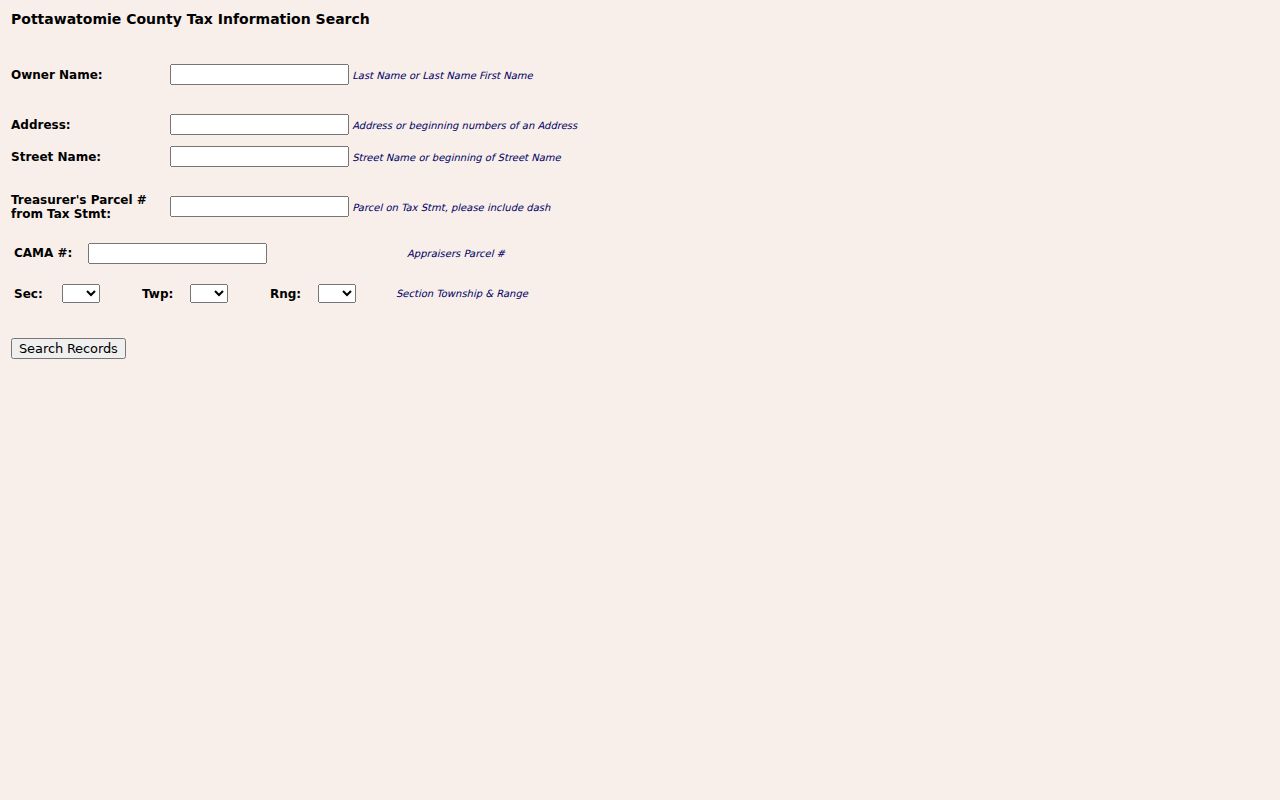
The official tax search offers seven search fields. Choices include owner name, address, street name, Treasurer's parcel number, Appraiser CAMA number, and section, township, and range. Omit dashes from CAMA numbers, and pair a street name with a beginning number when the full address is stored differently.
| Portal field | Useful for | Check |
|---|---|---|
| Owner Name | Taxpayer or entity | Exact roll spelling |
| Address / Street | Site or block | Situs, not owner mail |
| Treasurer Parcel # | Tax account | Copy formatting |
| CAMA # | Appraiser join | No dashes |
| STR | Rural tract | Legal land grid |
The captured screen shows the live county search fields.
Save the parcel and CAMA numbers with any printed or downloaded payment history. Those identifiers let another office reproduce the same match later.
Five Years of Payment History Are Available Online
The Treasurer offers five years of tax-payment history online. That window covers recent installments. Older proof, or a payment not yet posted, may still need confirmation from the office.
Check the account date and tax year. A current owner can run into a prior owner's payment inside the same parcel history, and special assessments may sit beside the ordinary property tax. Keep the tax account separate from any deed chain.
Kansas Classification Rates Shape the Assessment
Kansas classification rates drive the math. The county's real-property guidance lists the classes. Residential property is generally assessed at 11.5 percent. Commercial and industrial property sits at 25 percent. Agricultural land is assessed at 30 percent of use value. Vacant lots sit at 12 percent. Other stated classes run at 30 or 33 percent. Multiply appraised value by the class rate for assessed value. Farm use value is not open-market value times 30 percent. Confirm classification and use before comparing nearby tracts. The mill levy then applies to assessed value, and the statement may add special assessments.
March Through June Sets the Pottawatomie Tax Cycle
The county tax calendar sketches the yearly rhythm. Valuation notices go out around March 1. Informal hearings and appeal activity follow, with the real-property roll certified by June 1. The date on your own notice controls, so a calendar overview never replaces the mailed deadline. The Appraiser revalues property every year. It draws on cost, income, and market approaches as they fit, and a property record card can test building measurements, rooms, construction, and condition while comparable-property data tests whether the market evidence was applied evenly.
Special Assessments Sit Beside the Regular Levy
The county Treasurer warns that a statement can carry special assessments for streets, sewer, water, mowing, or other charges. No mill-levy multiplication explains those lines. Identify each one. Contact the originating jurisdiction when the basis is unclear. The county exemption page also does not list every real-property exemption. Never assume an exemption from a program label. Ask the Appraiser which form, eligibility rule, and filing period fit the parcel.
Delinquency and Tax Sale Require Current Confirmation
Unpaid real-estate taxes can move toward statutory sale. Redemption is governed by state law, including K.S.A. 79-2401a. A portal balance is only a starting point. It does not confirm a pending sale date, redemption amount, or legal status. Call the Treasurer with the parcel and tax year. If a court case is involved, consult the Pottawatomie County District Court and Kansas CaseSearch, keeping in mind that the online view can be narrower than the courthouse terminal.
Look Up a Pottawatomie County Tax Bill
The Treasurer search takes several routes. Owner, address, street name, Treasurer parcel, Appraiser CAMA number, and section, township, and range all work; start with the property address. Confirm the parcel before trusting the account.
- Search the Treasurer by address, owner or parcel key.
- Match the site and owner, then read the current bill and payment history.
- Compare the Appraiser's classification and assessment.
- Ask the Treasurer about delinquency or sale status that is unclear online.
- Assessed value
- The appraised amount multiplied by the classification rate.
- Mill levy
- The rate applied to assessed value to calculate tax.
- Exemption
- A legally authorized removal or reduction from taxation.
- Tax lien
- The government's claim arising from unpaid property tax.
Why the Pottawatomie Tax Roll Is Not a Deed
The tax roll identifies the account. It is used for assessment and collection, and it may show an owner name, mailing address, and parcel. It is a snapshot, not proof of transfer. A freshly recorded deed can outrun the certified roll. For ownership, take the deed book and page or legal description to the Register of Deeds. Boundary questions call for the county map as context and a survey for legal certainty. This keeps tax research focused on value and payment.
Prepare Evidence from the Property Record Card
The property record card explains why a valuation moved. It lists building measurements, room counts, construction, condition, acreage, and other characteristics. Check those facts against the parcel first. Debate the market judgment later. A factual correction and a dispute over comparable sales are different issues. Document each one separately.
The county describes cost, income, and market approaches. Good evidence includes photographs tied to the valuation date, contractor notes on condition, a survey or plat clarifying acreage, and genuinely comparable sales with their differences spelled out. Level 3 sales data is limited to authorized users, and the 2026 agreement says online COV access is unavailable, so ask the office what assistance it can provide.
Use Both Office and Online Tax Channels
The online portal works well for a quick search and recent history. For current postings, delinquency totals, or redemption amounts, the Treasurer's office remains the authority. Call or visit the counter. This helps when a payment is in transit or a special assessment makes no sense. Any mailed payment or receipt should state the parcel number and tax year.
Valuation questions go to the Appraiser. Collection questions go to the Treasurer. A KORA request filed with the County Clerk reaches broader county records. It cannot shift these custodial duties. Direct each question to the office that created the record. That almost always yields the clearest answer.
Read Classification Before Comparing Nearby Taxes
Two neighboring parcels can owe very different taxes despite similar appraised values. Classification drives much of the gap. Residential, commercial, vacant-lot, and agricultural classes carry different assessment rates. Agricultural land is valued through a use-value system rather than market sale. Taxing-unit boundaries, exemptions, and special assessments can diverge across a single road. They can also differ within one subdivision.
Start with the county GIS taxing-unit and school-district layers for context. Then verify the actual account with the Treasurer. Map layers change, and a map is never the billing record. On the Appraiser side, confirm land class, improvements, and acreage on the property record card. On the Treasurer side, line up assessed value, mill levies, special charges, and posted payments. Use the same tax year throughout.
The county publishes no comprehensive list of real-property exemptions. A motor-vehicle or military exemption does not extend to land. Ask the Appraiser for the exact statute, form, filing window, and documentation. These must apply to the parcel exemption being claimed.
If a gap still needs explaining, build a year-by-year table. Include appraisal, class, assessment, and bill. That format separates a value change from a levy change or a one-time special assessment. It also gives staff a specific question to answer.
Separate Appraiser Questions from Treasurer Questions
The Appraiser sets classification, property characteristics, and value. The Treasurer manages tax accounts, takes payments, and reports payment history. A value dispute belongs with the Appraiser. A missing payment or payoff figure belongs with the Treasurer. Routing each issue to the office that created the record avoids contradictory informal answers.
Bring the situs address, parcel number, owner of record name, and tax year. Bring them to either office. For a value question, add the property record card and the valuation notice. For a payment question, bring the receipt, payment date, and payment method.
Track the Bill by Tax Year and Installment
A five-year online history can mix several owners in one place. It may also blend payment dates and tax years for a single parcel. Label every amount by tax year, installment, and posting date. A deed date and a tax due date come from different systems. Never infer an ownership transfer from a payment line.
If the account shows delinquency, ask the Treasurer for a current figure before acting. Interest and costs can change what is due. Sale proceedings and redemption can change it too. That holds after any portal screen is viewed.
Compare Values with the Same Valuation Date
Market conditions and improvements shift over time. Compare parcels using the same valuation year and a similar property class. Check building measurements, condition, acreage, use, and location. A nearby sale may look helpful but fails as a comparable when the parcel is agricultural use land, vacant land, or a different commercial class.
Record where each number came from. Appraised value belongs to the Appraiser record. Assessed value flows from classification. Recorded sale information may sit behind a subscription level, and the tax due comes from the Treasurer statement.
Preserve the Appeal Record
Keep the whole appeal file together. That means the valuation notice, filed form, delivery proof, photographs, comparable analysis, property card, and every decision. Note the informal meeting date and the next appeal route the county states. Payment under protest follows its own procedure, so do not assume it duplicates the notice appeal.
Deadlines shift by year and by individual notice. The county calendar offers orientation only. The printed notice and current Appeals office instructions control. If a deadline or required form is unclear, request written confirmation.
Confirm Special Charges with Their Originating Jurisdiction
A Treasurer statement can carry street, sewer, water, mowing, or other special assessments beyond the ordinary levies. Write down the description, amount, and tax year. Then ask which city, district, or county department originated the charge. The Appraiser cannot resolve it just because the parcel sits on the valuation roll.
For property near a city edge, confirm jurisdiction in GIS first. Wamego's extraterritorial area and the cross-county geography of Manhattan and St. Marys complicate assumptions drawn from a mailing city. The bill and the originating assessment record, not the ZIP label, establish the charge.
Challenge a Pottawatomie County Assessment
The county tax calendar sends real-property valuation notices around March 1. A statutory appeal period and an informal Appraiser meeting follow. The real-property roll is certified by June 1. Owners should rely on the deadline printed on their notice and gather the property record card, measurements, condition evidence, and comparable sales information for Pottawatomie County parcels.
Choose the correct appeal route. Kansas treats a notice appeal and payment under protest as separate routes. Follow the county form and deadline for the selected route rather than attempting both.